
Ain’t they black!
“Ain’t they black!”
Negotiating Blackness and Borders
in Canadian Young Adult Literature
Last fall I reached my tipping point. After spending just one year as a fledgling member of the kidlit blogosphere, I poured my accumulated rage and frustration into an open letter to the children’s publishing industry. How could it be that with two black girls now living in the White House, African and African American authors are credited with less than 2% of the five thousand books published for children in the US each year?[i] As a black woman, marginalization is not a new experience for me, and so I found myself invoking—once again—this unfortunate aspect of my Canadian childhood:
I grew up in Canada in a semi-rural community on the outskirts of Toronto; I grew up without any stories that featured children of color, save the extraordinary books of Ezra Jack Keats. In a country that regularly boasts of its commitment to multiculturalism, I grew up not dreaming in color, and the first picture book story I ever wrote featured a white protagonist. I grew up never knowing black people could write books; I never met a black author or illustrator, and I suspect that most children in Canada are living that same sad reality today (thirty years later).
I have lived in the United States for the past fifteen years and when I confront racism here, I invariably think of Canada’s multicultural rhetoric and the broken promises that helped to drive me across the border. As Louise Saldanha asserts, “despite multicultural exertions to the contrary,” people of color often experience Canada as “a place of non-belonging, a place not-home.”[ii] When they learn that I am Canadian, some Americans question my decision to emigrate, especially as the health care debate rages on. It isn’t always easy to explain why I chose to leave the wealthy, socially progressive land of my birth. It can be hard to make others understand how the golden tale (or Olympic spectacle) of multiculturalism actually “disguises Canadian realities through declamations pronouncing us as all equally ethnic, declamations that make cultural and racial inequities appear not part of Canada.”[iii]
Despite the persistent delusion (held by a tiny minority) that the US is now “post-racial,” I think most Americans understand that racism is an ongoing, unresolved dilemma. My online plea for greater diversity in children’s literature garnered some sympathetic responses, but it did not magically transform the policies and practices that exclude most black people from the publishing arena. Here in the US, it’s a topic some folks would rather not discuss, including those authors of color who are still struggling to gain a foothold in the industry. The few established authors have no real incentive to rock the boat, and so I often feel like I’m on my own, doomed to repeat this Sisyphean cycle of incredulity, indignation, and resignation.
Marginalized people know that staying angry all the time is not an effective way to right a wrong. I suspect I’ve already earned a reputation as “an angry black woman,” which only justifies the dismissal of my concerns by the publishing powers that be. Yet I continue to advocate for change because I cannot accept the idea that children today may be growing up in the same appalling state of ignorance that slowed my emergence as a writer. 21st-century kids now know that a black man can become president of the United States—but do they know they can become poets, editors, novelists, illustrators, or playwrights? As a teen, I was bused up to Stratford every other year; I clearly remember studying the plays of Shakespeare and Tennessee Williams at my majority-white high school, but it never once  occurred to me that a black person could write or even star in a play. And it wasn’t until 2005, after more than half a century, that the Stratford Shakespearean Festival presented a play (Djanet Sears’ Harlem Duet) that was written, directed, and performed by blacks. By that point I was already in my thirties and had lived in the US for more than ten years; it was in New York, not Toronto, that I discovered (and joined) the long tradition of blacks in the theatre. Do teens in Scarborough today study black playwrights in school? Do they believe that a future in the arts is possible for them in Canada?
 Posting that open letter on my blog did yield some results. Two professors wrote me to say that my letter would now be required reading in their classes, and the Editor in Chief of Horn Book asked me to write something for their magazine. In “Decolonizing the Imagination,” I discuss the impact of rarely seeing people of color in the books I read as a child: “Perhaps the one benefit of being so completely excluded from the literary realm was that I had to develop the capacity to dream myself into existence.” I also accept partial responsibility for giving up on a future in Canada:
Many years after leaving Canada, I realized that I never believed anything magical could happen to me there. Whether I attribute that to a failure of my own imagination or to external factors, the result was that my dreams took root in a foreign land.
I left Toronto in 1994, but did return for two six-month periods during which I tried to interest Canadian publishers in my many manuscripts. In 1999 I completed my first novel, writing by day in my sister’s solarium and crashing each night on her couch. I left the TV on in the next room with the volume turned up just enough so that I could hear when David Usher’s video for “St. Lawrence River” came on MuchMusic. I checked CNN at least once a day in order to follow the Amadou Diallo case. I met Larry Hill and went through the list of Canadian agents he generously shared with me; nearly every agent and editor I approached wanted to see my manuscript (I write a killer query letter).[iv]
The first agent kindly pointed out that in one chapter I had written “Alberta” instead of “Roberta Flack.” She thought the manuscript had real promise, however, and assured me she could make my characters sound “more like Brooklyn blacks.” She did offer to represent me but when I questioned the terms of her contract, I never heard from her again. The last Canadian agent I dealt with that year said my characters seemed “racist.” Frustrated but certain I would have better luck with black agents in New York, I went online, found a job teaching teens in the Bronx, and hitched a ride with my father back to the States.
 Five years later, most of my writing was still unpublished and I found myself back in Toronto once more. My father had succumbed to cancer and my ten-month teaching gig in east Africa fell apart after just five weeks. I moved back home with my mother and wrote to keep myself sane; within a month I had produced a memoir, and I gave it the title my father once gave me: Stranger in the Family. I didn’t have the same luck with agents this time around; after yet another rejection, I emailed one agent and asked why black women couldn’t get published in Canada. She assured me I was mistaken, named a slew of black female authors I’d never heard of before, and directed me to a certain small press. The managing editor there expressed interest in my memoir and said her external reviewer was “madly in love” with my young adult novel, A Wish After Midnight. But after several months of meeting for lunch and exchanging endless emails, no contracts materialized; I sent Wish to two other small presses in Toronto and was given equally disheartening news. One press was interested in the book but only if I cut out the historical section; since Wish is a time-travel story, that would have meant losing two-thirds of the novel and its sequel (which was already in progress). The other press said they admired my writing, but didn’t have the capacity to market my book in the US. And they would have to, it seems, since the novel is set in Brooklyn. Apparently no one in Canada wants to read about black folks who live in the United States.
 Once again, I resolved to pack my bags and return to New York. In 2008, I self-published my memoir, my young adult novel, and two collections of plays. That fall, my first picture book was published by Lee & Low, a small multicultural press; Bird won numerous awards and honors, but no newspaper in Canada would review it and Chapters Indigo refused to sell it. In 2009, Amazon started its own publishing wing and acquired the rights to A Wish After Midnight. The “new” edition (same book, different cover) was released in February 2010; Wish was featured in USA Today, I was interviewed on three radio shows, we got fantastic reviews, and The Huffington Post asked me to blog for them. My first post, “Breaking Down Doors,” outlined my long, difficult journey to publication. My second post, “Demanding Diversity in Publishing,” proposed that the US follow the UK’s lead in adopting a Publishing Equalities Charter. I think Canada should do the same.
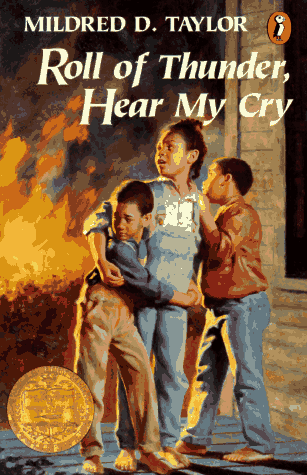 I appreciate the mission of publishers to promote, preserve, and protect Canadian culture. American cultural imperialism is a very real threat, yet American books were the only ones in my Canadian library that showed black children on the cover. I adored the picture books of Ezra Jack Keats, and in those books (written and illustrated by a white Jewish Brooklynite) I finally found the mirror I craved as a child.[v] Mildred D. Taylor’s middle grade novel, Roll of Thunder, Hear My Cry was my introduction to race relations in the Jim Crow South. After reading this book (and its sequel, Let the Circle Be Unbroken), I penned my first story that did NOT have a white protagonist. Without those books from the US—without television shows from the US, without magazines from the US—I would never have found a mirror for my black female self in Canada. Not in the 1970s and ’80s.
Are Canadian publishers doing a better job today? I think so. I recently queried some of the most respected children’s presses in Toronto and received a very short list of young adult novels that feature black protagonists: two were set in Cuba, one in Rwanda, one in South Africa, and the other in Mali. When I looked for picture books, most were set in the Caribbean. Apparently no editor claimed they couldn’t publish these books due to their inability to market them abroad; all were deemed suitable for the Canadian market. So what was it that made my work so unpalatable? Anti-US sentiment, or a preference for more “exotic” locales?
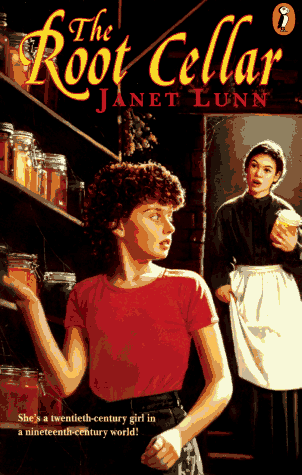 When she learned I was writing a time-travel novel, my cousin (who is white) shared with me one of her favorite childhood books, Janet Lunn’s The Root Cellar (1981). In this story, a wealthy, orphaned white girl from New York is sent to live with relatives in Ontario and magically finds herself transported back in time. Rose’s real adventure, however, begins when she travels back across the border to the US and passes as a boy after the Civil War. As their train pulls into Syracuse, Rose and her white Canadian companion, Susan, share this bizarre exchange:
Through the window they watched the busy crowds. There were many soldiers and the number of black people amazed Susan. “I ain’t never seen but two before,” she whispered. “They come across the lake with Captain Armitage. They’d run off from being slaves. They was kind of sad. I don’t know where they went after. Ain’t they black!”
“I suppose so. I’ve never thought about it. There are lots of black people in New York, as many as white people, I think. Susan, let’s get something to drink.”[vi]
I know my cousin hoped I would also love The Root Cellar, and I might have—in 1981. But as an adult, the book rubbed me the wrong way. Susan’s ignorance and indifference reminded me of what my African American ancestors likely faced when they bought their freedom and migrated to Ontario in the 1820s; her inability to recall “where they went” mirrors the invisibility of blacks in the narratives I was fed as a child (the novels at my local library and the textbooks assigned in my schools). Why did Lunn choose to make her protagonist American? And why did her Canadian characters have to cross the border to encounter the very same blacks who were already living in their midst? For Susan, African Americans (in numbers greater than two) are a source of curiosity but also anxiety; it is only after she meets John and Sally—who prepare her bath, scrub her clothes, and make her food—that she concludes, “Blacks is nice.” How would I have felt as the only black student in my fifth-grade class as this book was read aloud? Was I, by then, already accustomed to de-racing myself in order to fit in? Would I have identified with the heroic white protagonist, or would I have been shamed by my obvious affiliation with the docile black servants?
 In my time-travel novel, A Wish After Midnight, blacks take center stage. Like Janet Lunn, I am indebted to Frances Hodgson Burnett’s The Secret Garden; my protagonist haunts the Brooklyn Botanic garden and there finds the portal that leads to the past. But my main characters, Genna and Judah, are brave, strong, and resilient (they’re also dark-skinned—“ain’t they black!”). Both teens actively engage with the people they encounter in Civil War-era Brooklyn as they desperately try to shape a future where they can be free. The whites in my novel are marginal yet complex, their brief moments of heroism dimmed by their unapologetic bigotry. The black characters are diverse, with distinct voices, opinions, and personal histories. It would be interesting, I think, for students to read The Root Cellar and A Wish After Midnight together. But that isn’t likely to happen since Wish still hasn’t been reviewed in any Canadian newspapers, and once again is not being stocked at Chapters. [vii]
Perhaps my writing fails to be foreign enough. Despite the endless efforts to differentiate Canada from the United States, perhaps the urban worlds I create aren’t sufficiently different from the city spheres occupied by teens in Toronto, Montreal, or Winnipeg. Louise Saldanha argues that notions of “‘home’ and ‘away’ centrally occupy children’s literature in North America,” with “away” marking “the space of forests and similar unsettled, unsettling realms, the zone of strangeness and the zone of insecurity.”[viii] Perhaps my stories are actually too familiar, generating anxiety around “domestic” blackness, racism, and those for whom Canada is their country of origin but still is not fully their “home.”
[i] These statistics are the latest (2008) compiled by the Cooperative Children’s Book Center; two Canadian presses, Groundwood and Tundra, submit their books for inclusion in this ongoing study: http://www.education.wisc.edu/ccbc/books/pcstats.asp.
I was not able to locate an organization in Canada that compiles comparable statistics on the percentage of children’s books by and about people of color. The Canadian Children’s Book Centre asserts that, “based on the books that are submitted to our organization, over 500 English-language books are published for children each year in Canada.” I have put together my own table, which can be found here.
[ii] Louise Saldanha, “White Picket Fences: At Home with Multicultural Children’s Literature in Canada?” in Home words : discourses of children’s literature in Canada, edited by Mavis Reimer (Waterloo, Ont.: Wilfrid Laurier University Press, 2008) 131. I would like to thank Perry Nodelman for directing me to this important essay.
[iii] Saldanha 130.
[iv] “As an avid reader and scholar of black women’s literature, I have become aware of marked gaps in the literary tradition, particularly in the representation of young black women’s lives. Although the audience for black women’s writing has continued to expand in recent years, stories that specifically address the concerns of younger women are difficult to find. Established writers like Toni Morrison and Alice Walker have shown that the particular perspectives of black women warrant literary attention, and the emergence of younger writers such as Zadie Smith, Edwidge Danticat, and asha bandele indicates that the field is, in fact, widening. Yet the voices of young Canadian women of my generation are seldom heard, and are rarely featured in serious literary texts.
I have attempted to remedy this situation by writing a novel that is set within the vibrant, diverse, and often troubled black communities of Brooklyn. One Eye Open is the story of a young black woman, twenty-five year old Nina Traymore, who was raised in the city by her father after her mother unexpectedly left the family and the country for a freer life abroad. One Eye Open examines the intersection of desire and ambivalence; Nina fears and hopes for the future, but also fears and resents the past, leaving her alternately paralyzed and catalyzed by her own yearning. Embittered by her mother’s abandonment, and by the trauma that persists years after she is brutally raped by a male acquaintance, Nina tentatively sheds her cold exterior and opens herself once more to the possibilities of love. As she struggles against the violent forces threatening to destroy her inner city neighborhood, Nina also attempts to negotiate her conflicting sexual desire for Isaiah Edwards, a young black man who re-enters the community with his own turbulent history. With his love, and the support of her best friend, Vinetta, Nina ultimately reconciles herself to her past and determines to build a space of healing within herself, and in her beloved yet beleaguered community.”
[v] Rudine Sims Bishop writes: “Books are sometimes windows, offering views of worlds that may be real or imagined, familiar or strange. These windows are also sliding glass doors, and readers have only to walk through in imagination to become part of whatever world has been created or recreated by the author. When lighting conditions are just right, however, a window can also be a mirror. Literature transforms human experience and reflects it back to us, and in that reflection we can see our own lives and experiences as part of the larger human experience. Reading, then, becomes a means of self-affirmation, and readers often seek their mirrors in books.” Conversely, “When children cannot find themselves reflected in the books they read, or when the images they see are distorted, negative, or laughable, they learn a powerful lesson about how they are devalued in the society of which they are a part.” From “Mirrors, Windows, and Sliding Glass Doors,” in Perspectives: Choosing and Using Books for the Classroom (Vo. 6, no. 3. Summer 1990). You can also find the complete essay here: http://www.rif.org/multi_campaign_windows_mirrors.mspx
[vi] Janet Lunn, The Root Cellar (1981; New York: Puffin Books, 1996) 121.
[vii] Wish is available on Chapters’ website, but must be ordered in-store; the same is true of Book City. The Toronto Women’s Bookstore carried my self-published edition of Wish.
[viii] Saldanha 129.
Bibliography
Bishop, Rudine Sims. “Mirrors, Windows, and Sliding Glass Doors.” In Perspectives: Choosing and Using Books for the Classroom. Vo. 6, no. 3. Summer 1990.
Lunn, Janet. The Root Cellar. 1981. New York: Puffin Books, 1996.
Saldanha, Louise. “White Picket Fences: At Home with Multicultural Children’s Literature in Canada?” In Home words : discourses of children’s literature in Canada. Ed. By Mavis Reimer. Waterloo, Ont.: Wilfrid Laurier University Press, 2008.
Older Post ❱❰ Newer Post
0 Comments