
Dragons & Daring in MG fiction
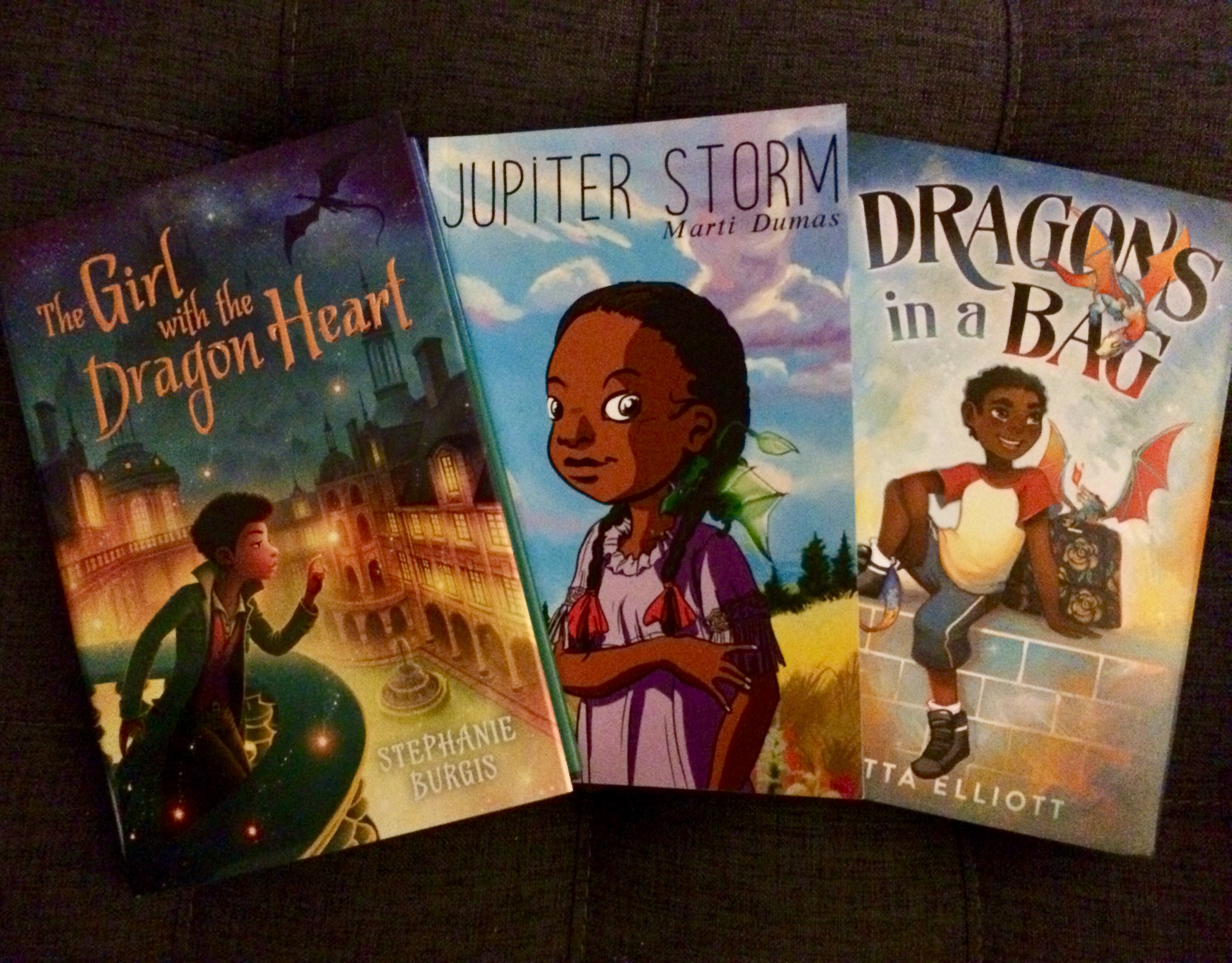 Does it really take guts to write about dragons? They’re loved by kids, teens, and adults but when you introduce Black authors and/or characters, dragon tales become potentially radical. I met Marti Dumas at the Kweli Color of Children’s Literature conference last spring, and Stephanie Burgis recently invited me to write a guest post for her blog. I decided to ask these two “dragon ladies” to reflect on the ways race and fantasy intersect in their books for kids. Let’s begin!
Zetta: Dragons in a Bag is about a boy who has to decide whether or not he wants the job his mother turned down: apprentice to a witch! Ma is about to retire but she needs help to complete one last mission—delivering three baby dragons to the realm of magic. Of course, things don’t go as planned and Jaxon has to prove just how resourceful he is in order to make things right. He almost succeeds but is foiled by The Dragon Thief (Book #2, coming next year). Tell us about your dragon tale, please!
 Stephanie: The Girl with the Dragon Heart is the second book in my Tales from the Chocolate Heart series, set in a magical world full of dragons, fairies, and truly delicious chocolate. The first book (The Dragon with a Chocolate Heart) starred Aventurine, a fierce young dragon who went out hunting for a human to eat and instead was transformed herself into a human when she drank a pot of enchanted hot chocolate. The Girl with the Dragon Heart is the (standalone) story of her best friend, Silke, a fantastic human girl who’s already used her brilliant storytelling skills to win herself a waitressing job at the chocolate house where Aventurine works. Now, she’s offered the chance of a lifetime when the ruthless Crown Princess of Drachenheim hires her to spy on a group of mysterious and dangerous fairy royal visitors. Unbeknownst to the Crown Princess, though, Silke has her own personal history with the fairies of Elfenwald – and it’s going to take all of her courage and cleverness to protect both her fiery best friend and their entire city from the fairies’ sinister plans.
Marti: Jupiter Storm is about a little girl who nurtures a chrysalis, but instead of releasing a butterfly, her chrysalis births a dragon.
Zetta: Hugo Award-winning author NK Jemisin asserts that it’s political for a Black woman to write about dragons. Was that the case for you, Marti?
 Marti: My mother, a black woman who was barely five feet tall, was one of seven children and the darkest in the family. Her name was Jacquelyn but her siblings used to call her “Black-lyn,” and it wasn’t meant as a compliment. She was also one of the smartest people I have ever met, no hyperbole intended or needed. I set out to write a story about dragons that I would have wanted to read as child, but as much as I intended to write something “cute” and “light” and “adventurous,” what happened instead was I wrote about my mother. My mother, who died of cervical cancer about 15 years ago, was the only character who would make the story go for me. No one else was so intelligent, so capable, and yet so incredibly discounted and overlooked that she would be able to raise a dragon right under people’s noses. So in that sense, yes. I suppose NK Jemisin was right. It was political.
What strikes me for you, Zetta, is less the how and more the why. Of all the creatures, all the symbols you could have chosen to put in a little mint tin, why choose dragons? Do you agree with Jemisin’s statement that it’s political for a black woman to write about dragons?
Zetta: Well, I’d already written about a phoenix and a unicorn, and I’m working on another City Kids book about gryphons so I was running out of mythical beasts! I’ve always loved dragons and my friend Marie sent me four tiny rubber ones as a gift. I wanted to carry them with me so, like Ma, I dumped out the contents of my mint tin and tucked them away in my bag! I’m not a witch but sometimes I do feel invisible—especially in the publishing arena. Black authors are generally expected to write realistic or historical fiction about oppression but if you’re more into speculative fiction, then YOU become the unicorn and they don’t know what to do with you. I’ve had to self-publish most of my fantasy fiction, and the dynamic of exclusion and resistance always feels political to me. Magic is about power and fantasy fiction helps young readers to feel empowered. It’s telling that publishers have denied Black and brown kids their fair share of magical stories for so long.
Stephanie, you’re a White woman and yet your protagonist is a Black girl, which is just as political. How did she find her way into your novel?
Stephanie: Silke was first introduced in The Dragon with a Chocolate Heart, where she became Aventurine’s best friend – and although Aventurine’s own main arc finished at the end of that first book, by that point I had fallen head-over-heels in love with Silke herself and knew she needed her own adventure. It was really important to me that the fantasy world of these books should be richly inclusive, so (among other things) the characters introduced in Book 1 had a variety of skin colors. As each story in this trilogy stars a different heroine (each of them a strong, compelling girl first introduced in Book 1), only one of those heroines (Aventurine) was White. (The third book stars the younger princess of Drachenheim, Sofia, who is biracial.)
 Zetta: Is the demand for diverse books as high in the UK? I notice your publisher made two different covers for your book and the US one is particularly striking—a magical Black girl with an Afro!
Stephanie: There is a serious problem with lack of diversity in children’s literature in the UK, even more so than in the US. However, there is definitely a demand for diverse books, and I love the books of current BAME kidlit authors like Catherine Johnson, Candy Gourlay, and Emma Shevah. My international covers have always been really different from each other, and I love both my US and UK covers – but I have to say that the US cover is the one that looks most like Silke to me!
Zetta: The most familiar dragon narratives in US culture tend to come out of a European storytelling tradition. Do you write against or within that convention, Marti?
Marti: I wish that I could say that I was doing neither, that I was writing a story that came wholly of myself, but if I did it wouldn’t be true. I grew up in New Orleans. No matter how other-worldly and non-American it may seem from the outside, New Orleans is still the United States. So, just like so many others who grew up in the states, European standards have been fed to me since before I was aware enough to notice, sometimes without the people who fed them to me knowing that that’s what they were doing. Those  standards, those stories are definitely in there and serve a baseline for my experiences as first stories so often are. I don’t necessarily think that’s a bad, thing, though. I found little pieces of myself in those stories, but so much of me was missing, too. So when I write about dragons, part of it comes from what I know of European mythologies, but so much more comes from what was missing for me when I was growing up. Those stories were closed. Even though they were fed to me, they were not for me. It’s only because I’m hard-headed that I wedged myself into them, but I intend to wedge a hole large enough for others to follow. The dragons in my stories are from all around the world, each steeped in their own local histories and remembered by their own mythologies. It just happens that the first one we discover is through the eyes of a little black girl in New Orleans and, besides the fire, goes very much against the European type. Which is only as it should be. He’s a Louisiana dragon, not a European one.
Is that true for you, Stephanie? Do you find yourself drawn to European narrative conventions?
Stephanie: I wrote these books very much within the Germanic fairytale tradition – in fact, I based the culture of my fantasy kingdom of Drachenheim on a late-18th-century/early-19th-century German kingdom (but with added magic, and the flexibility to give women and people of color more visible power all throughout society!). All of the chocolate-making described in the books is based on 18th-century recipes and processes, too. My only real tweaks to the fairytale tradition came in making a dragon the heroine rather than the antagonist (as in most fairytales!) in the first book – and in making my dragon a truly ferocious girl (even when she’s in human form). I always want more girl dragons in stories AND more ferocious girls in general!
Zetta: Why draw on German traditions when you live in Wales? There’s a dragon on your flag!
 Stephanie: I love the dragon culture of Wales! And moving here definitely inspired me to write dragon books. Every time I walk through town, I see dragons in so many shop windows as well as on the national flag. We live surrounded by mountains which are often mist-covered, and my sons and I always tell stories about the dragons who live inside the mountains (just like the dragons in my books!) and only come out nowadays to fly around the mountains when they’re protected by the mist. When it comes down to it, though, the German fairy tales are the ones I was raised on – and in many ways, the city of Drachenburg in my books is based on Vienna, where I lived and worked for two years. So those are still the dragons that most influence my story-brain!
 Zetta: I can relate—Brooklyn definitely shaped my stories when I lived there.
Stephanie: What was your favorite scene to write in Dragons in a Bag?
Zetta: That’s funny—I don’t think of separate scenes when I think about my books! I often think about how I felt when I was writing. I didn’t know in the summer of 2016 that I would be moving to Philadelphia a couple of years later, but I definitely felt the pressure of gentrification and that found its way into the novel. Brooklyn had been changing for quite a while but it no longer felt like a place where I could thrive as an artist. So I identified strongly with Ma—I felt weary, cantankerous at times, and impatient with oblivious newcomers to my neighborhood. Her early interactions with Jaxon were a lot of fun to write, and I almost laughed out loud recently when sharing with kids the passage where she interrogates him about the marshmallows…
* * *
Thanks for sharing your dragons tales with me, ladies! I look forward to following the adventures of your smart, feisty characters…
* * *
 Stephanie Burgis grew up in East Lansing, Michigan, but now lives in Wales, surrounded by mountains, castles and coffeeshops. Her book The Dragon with a Chocolate Heart won the Cybils Award for Elementary/Middle Grade Speculative Fiction 2017, and her book Kat, Incorrigible won the Waverton Good Read Children’s Award for best début novel by a British children’s writer. She also writes romantic historical fantasy novels for adults and has published nearly forty short stories in various magazines and anthologies. You can read excerpts from all of her books on her website: www.stephanieburgis.com
 Marti Dumas is a mom, teacher, writer, and creative entrepreneur from New Orleans. An expert in childhood literacy, Marti has worked with children and teachers across the country for the last 15 years to promote an early love of reading both in and out of the classroom. Her best-selling Jaden Toussaint, the Greatest series combines literacy with STEM skills, and humor, and adds much-needed diversity to the children’s chapter book landscape. Her latest book, Jupiter Storm, is a middle-grade fantasy that is already being heralded for its skillful combination of science, family, and magic. The Dragon Keep, the second book in the series, is coming in March 2019.
To learn more about me (Zetta), see my bio.
Older Post ❱❰ Newer Post
0 Comments